

Infectious Disease Testing
Time to Result Can Change Everything
When accuracy and time to result guide treatment decisions, reliable quality control has to keep pace with how fast molecular diagnostics now move.
A Field Moving Faster Than Its Own Quality Control
Molecular infectious disease testing now spans nearly every major clinical use case, and each one runs on a different chemistry that fails in its own way. Most quality control still treats them the same: an internal control built into a cartridge confirms a run completed, but it enters the workflow after the failure most likely to happen has already happened. Verification hasn’t kept pace with how specialized the testing itself has become.
Three Common Chemistries, Three Different Failure Points
PCR-Based Syndromic Panel
Lysis
→
Extract
→
Amplify
→
Detect
Fails quietly at lysis or extraction, before amplification ever begins.
Chemiluminescence-Based Assay
Lysis
→
Extract
→
Amplify
→
Detect
Fails quietly at detection, after amplification has already occurred.
PCR-Based Syndromic Panel
Lysis
→
Extract
→
Hybridize
→
Silver-Stain
Fails quietly at hybridization or the silver-stain step that makes a result visible.
Where QC Creates Value
Molecular infectious disease testing spans a growing range of pathogens and platforms. A control that only verifies the detection step can miss other important sources of failure.
Operator Performance Is In Scope
CLIA requires control procedures to catch errors from operator performance and rotate control testing among every operator who runs the assay.
Handled Like a Patient Sample
CLIA requires control materials to be tested the same way as patient specimens. A material that skips a step can’t fully meet that bar.
Extraction Gets Its Own Requirement
CLIA sets a separate control requirement for any test system with an extraction phase, and another for molecular amplification when inhibition is a realistic risk.
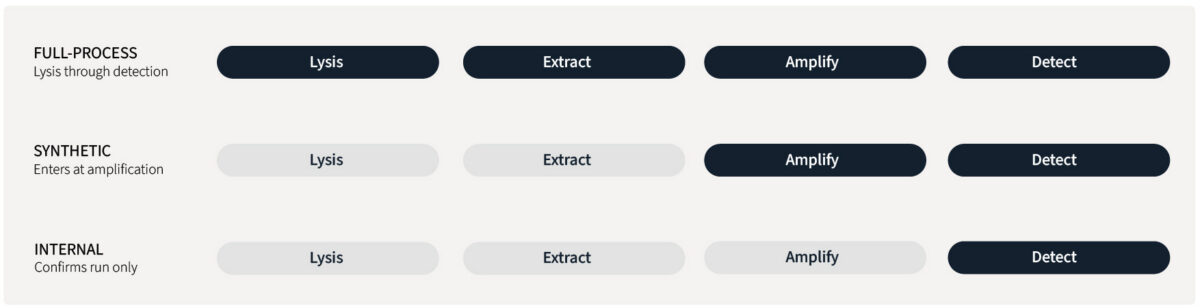
At a Glance: Where Each Control Type Enters the Workflow
Patients Depend on Accurate Results
Jackie Duda is a sepsis survivor whose illness progressed from early symptoms to septic shock.
Sepsis causes an estimated 350,000 deaths in the U.S. each year, more than stroke, prostate cancer, breast cancer and opioid overdoses combined (Sepsis Alliance). A blood culture identification panel is often the single test that determines when treatment starts, and the result only holds up if the lab running it can trust it, which is the argument above.

Behind Every Sample
Jackie’s Story and the Role of the Lab
Hear Jackie share her journey from early symptoms to septic shock, and how labs and clinicians can work together to deliver faster, more reliable results.
Use Cases & Applications
Four application areas, four different control problems. Each spoke page below states the specific requirement that governs its panel and the case for an independently built control to meet it.
Sepsis & Bloodstream Infection
Multiplex PCR run directly on a positive blood culture bottle identifies the organism and key resistance genes without waiting on subculture.
Respiratory Illness
One specimen tested against a panel of respiratory viruses and bacteria, distinguishing pathogens with nearly identical symptoms in a single run.
STI & Women’s Health
Nucleic acid amplification testing detects and differentiates multiple organisms from a single specimen in one run rather than a series of separate tests.
Antimicrobial Resistance
Multiplex PCR detects key resistance genes in Gram-negative bacteria directly, often ahead of a phenotypic susceptibility result.

Streck lays out the broader case for independent, third-party verification in our position paper.
Standards & Evidence
None of these failure modes announce themselves. A compromised control can pass visual inspection and clear a run without raising a flag, which is why standardizing verification matters as much as the assay itself.
Streck Position Paper
Why Third-Party Controls
Streck’s own case for independent, third-party verification, laid out in full.
Member Organization
APHL
The Association of Public Health Laboratories works to strengthen laboratory systems and public health infrastructure nationwide.
Scientific Research
Citation Library
Browse published research on molecular QC and full-process verification, searchable by application and platform.
Partner With Streck
Building a new molecular platform or expanding the test menu? We co-develop controls validated specifically for your technology, so your customers have what they need from day one.
- Regulatory support through validation and stability studies
- Custom formulations matched to your specific target panel
- A direct line to our technical team as your protocols evolve
- Room-temperature, patient-like formats from the first design conversation
Phase 1
Feasibility
Phase 2
Design Lock
Phase 3
Transfer to Manufacturing

Built for Full-Process Reliability
Streck’s molecular controls verify performance from extraction through detection on leading molecular diagnostic syndromic platforms, independently of the instrument or reagent manufacturer.

Sample-to-result process verification

Independent of instrument and reagent manufacturers

Validated for leading syndromic platforms
54+
years of scientific excellence
Zero
FDA recalls
70,000+
labs worldwide rely on
Streck products
ISO 13485
certified manufacturing