

Body Fluid Analysis
Critical Results From an Irreplaceable Sample
Cerebrospinal, synovial, pleural and peritoneal fluid often fall outside automated analyzers’ counting range and so a manual method is required. Technologists count cells and identify them, often from a sample that’s a fraction of a milliliter. Many of these samples are only drawn once, which is exactly why a quality control such as Cell-Chex® matters so much here — there is rarely a second sample to fall back on.

How QC Creates Value for Body Fluid Testing
Quality control touches nearly every step of a manual body fluid workflow, from the moment a technologist loads the hemacytometer to the number that reaches the chart. The three areas below are where laboratories tend to see it matter most.
Verifying Manual Counting
Certain body fluids may fall outside the range automated analyzers can count, so they’re counted and differentiated manually under a microscope. A control designed specifically for manual methods, such as Cell-Chex, gives the technologist a known result to check the count against before the patient value is reported.
Reducing Interobserver Variability
Manual counting methods are subject to significant interobserver variability. A study has shown that five technologists counting the same four CSF samples produced coefficients of variation as high as 91% at low cell concentrations.1
Accounting for Cell Morphology
Unlike a chemistry control, a body fluid control has to give the observer real cells and real crystals at the low-positive range. The low-positive range is also where manual identification is hardest, which is exactly why a control that challenges morphology is important.
CAP expects laboratories to run appropriate QC on manual body fluid cell counts, and it allows several ways to meet that expectation. The comparison below shows what each option can and cannot tell you:
| Control material | Reference Value | Crystal ID |
|---|---|---|
| Assayed liquid control (Cell-Chex) | Yes — manufacturer-assigned | Yes — real urate/CPPD crystals |
| Previously assayed patient sample, ran in duplicate | No — technique checked against itself only | Rarely — most samples carry no crystals |
| Procedural control | No — confirms the process ran, not the number it produced | No |
Evidence
The Interobserver Problem, Measured
At a mean of 0.6 cells per microliter, the manual coefficient of variation across five blinded technologists was 91 percent; even at 63.2 cells per microliter, it was 45 percent.1
Scientific Research
Crystal ID Responds to Training
In a reliability study of general (untrained) light-microscopy observers, mean sensitivity for crystal identification was 69% for urate and 82 percent for CPPD.2 In a separate study designed specifically to test the effect of a structured training program, blinded examination after training reached 95.3 percent sensitivity for urate and 92.7 percent for CPPD.3 CPPD remained the weaker call in both studies.
1. Sandhaus LM, et al. A New Automated Technology for Cerebrospinal Fluid Cell Counts. American Journal of Clinical Pathology, 2017;147(5):507–514. 2. Gordon C, Swan A, Dieppe P. Detection of crystals in synovial fluids by light microscopy: sensitivity and reliability. Annals of the Rheumatic Diseases, 1989;48(9):737–742. 3. Ortiz-Bravo E, et al. Analysis for crystals in synovial fluid: training of the analysts results in high consistency. Annals of the Rheumatic Diseases, 2005;64(4):612–615.
Standards & Evidence
Manual testing methods are subject to variability and thus highlight the importance of utilizing quality controls to ensure patient results. Below are links to published data and technical documents to support your laboratory’s QC program.
Products
IVD · FDA
ClearedCE-IVD
Cell-Chex®
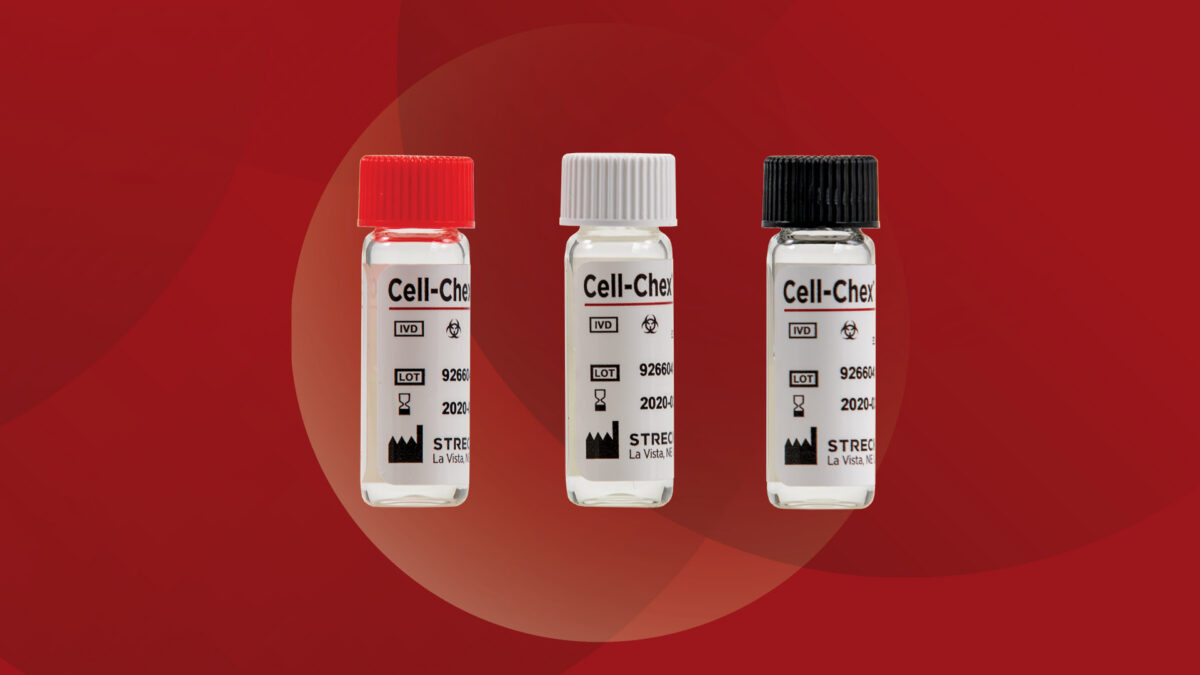
Multi-level manual control for hemocytometer counts. Assayed for a 5-part WBC differential and contains urate/CPPD crystals. 30-day open-vial stability and 6-month closed-vial stability.
Documentation & Standards

Current package insert, assay sheets, and certificates of conformance by lot. Plus the CLIA control-frequency requirement and CLSI H56-A consensus standard.
Resources
Regulation
CLIA 42 CFR 493.1269
The manual hemocytometer control-frequency requirement, in full, on eCFR.
Standard
Peer Data
STATS® ILQC
Interlaboratory program to benchmark your laboratory’s performance against peer groups.
Partner With Streck
Leading instrument manufacturers partner with Streck to provide their customers with dependable third-party quality controls. Streck is the leader in cell stabilization for over 50 years and continues to manufacture and develop high performing controls.
- Sophisticated R&D to rapidly develop products
- Advanced QC, with barcoded solutions and included ILQC program for increased value
- Highly trained technical and sales support

Built for the Hardest Call
Streck manufactures Cell-Chex from stabilized human cells and real urate and CPPD crystals so a technologist can verify the count, the differential, and the crystal identification against material with assigned values, handled exactly as a patient specimen is.
54+
years of scientific excellence
Zero
FDA recalls
70,000+
labs worldwide rely on
Streck products
ISO 13485
certified manufacturing