

Respiratory Testing
One Run, Many Pathogens, No Room for a Quiet Failure
Syndromic respiratory panels distinguish pathogens with nearly identical symptoms in a single run. QC has to verify that entire run, not just confirm a signal appeared.

Symptoms Overlap. Treatment Decisions Can’t.
Influenza, RSV and SARS-CoV-2 can look identical at the bedside, but call for different isolation precautions, antivirals and household guidance. A single high-plex PCR panel resolves that ambiguity in one run, testing the full differential the moment isolation and treatment decisions actually get made.
Where QC Creates Value
A respiratory panel that reports six or more targets from one specimen has six or more ways to fail quietly. As the Infectious Disease Testing overview lays out, PCR-based panels like this one tend to fail quietly at lysis or extraction, before amplification ever begins — and neither an internal control nor a fixed-schedule external control, on its own, fully exercises that part of the workflow.
Extraction & Amplification
Verifies the upstream steps, lysis and extraction, where most errors actually occur, well before a result reaches the step a lab is watching.
Patient Sample Similarity
Intact organisms in a matrix of blood and epithelial cells benchmark the full process the way a real nasopharyngeal specimen would.
Independent Verification
An unbiased check of the full test system, independent of whichever manufacturer built the assay being verified.

Run automatically with every patient sample, the internal control never travels through the workflow at all; it confirms only that the run finished. A synthetic control bypasses lysis and extraction entirely, so it never challenges the step most likely to fail on a specimen with a thick mucus matrix. Only a full-process control, built from intact, inactivated organisms in a patient-like matrix, exercises the workflow the way a real nasopharyngeal swab would — across every target on a high-plex panel’s list, and across every system a platform-agnostic control might run on. CLIA sets its own numbered requirement for the extraction phase — see Platform Coverage below.
Evidence
Same Specimens, Different Yield
A head-to-head study running the same 181 nasopharyngeal specimens through two multiplex respiratory panels found one detected viruses in 154 specimens where the other detected them in only 98, most of that gap concentrated in low-viral-load specimens.
Evidence
CLSI MM17
Multiplex assays don’t validate like single-target tests; CLSI MM17 recommends an error-based approach instead of traditional single-measurand validation.
What CLIA Requires, Whatever Platform You Run
42 CFR 493.1256(d)(3) sets the baseline control requirements for nonwaived testing, regardless of manufacturer.
- Extraction phase (d)(3)(iv): “Each test system that has an extraction phase, include two control materials, including one that is capable of detecting errors in the extraction process.”
- Molecular amplification (d)(3)(v): “Each molecular amplification procedure, include two control materials and, if reaction inhibition is a significant source of false negative results, a control material capable of detecting the inhibition.”
- Same regulation, broader scope: (d)(3)(i) additionally requires two control materials of different concentrations each day patient specimens are assayed, and (d)(8) requires them to be tested the same way as a patient specimen.
- One control per instrument falls apart: a control built for one system stops being useful the moment a lab adds a second platform to its respiratory menu.
- CAP Checklists: the Molecular Pathology and Molecular Microbiology checklists add further control requirements specific to molecular test systems.
- Confirm before publish: current CAP item numbers should be verified against the live checklist by Quality/Regulatory.
- Tuned vs. independent: Independent third-party controls may provide an additional source of quality monitoring that is separate from the assay manufacturer.
- One story at accreditation: a lab that can show one control strategy covering every respiratory platform it runs has an easier story to tell an inspector than a patchwork of manufacturer-supplied controls.
- Travels with the instrument mix: a platform-agnostic control keeps working as a lab’s respiratory menu and instrument mix shift season to season.
Two Controls, Two Coverage Strategies
One built for high-plex syndromic testing, one built to travel across whichever platform a lab’s respiratory menu runs on next. Both Research Use Only.
Both are manufactured from intact, inactivated organisms in a matrix of blood and epithelial cells, used the same way a patient specimen is used.
High-Plex Syndromic · bioMerieux Respiratory Panel Systems
Research Use Only
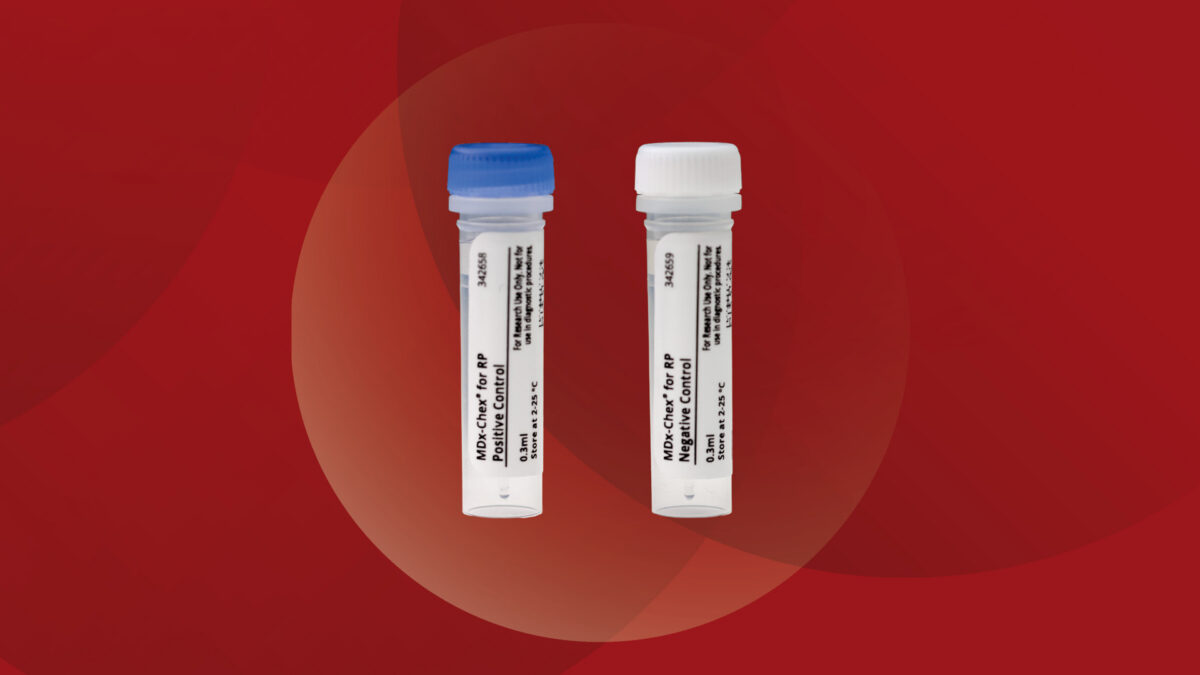
MDx-Chex® for RP
Full-process control for high-plex respiratory panels, compatible with bioMerieux respiratory panel systems.
Platform-Agnostic · Verified Across Multiple Systems
Research Use Only

MDx-Chex® for RLP
Covers Influenza A/B, RSV, rhinovirus, SARS-CoV-2 and Group A Strep, verified across multiple molecular diagnostics platforms.
Documentation
Regulation
Standard
Portfolio
Full Molecular QC Line
Browse every Streck molecular control across applications, not just blood culture.
Build Your Control Alongside Your Assay
Developing a new syndromic respiratory panel, or expanding an existing one to a new platform? Streck co-develops full-process controls validated specifically for your platform, working through feasibility, design lock and transfer to manufacturing alongside your own assay timeline rather than after it ships.
Built for Full-Process Reliability
Independently manufactured assays that include a positive control for every gene target and an internal control against inhibition, degradation and poor extraction, so a negative result means the gene truly isn’t there.
54+
years of scientific excellence
Zero
FDA recalls
70,000+
labs worldwide rely on
Streck products
ISO 13485
certified manufacturing