

Oncology Molecular Reference and Control Materials
A control should take the same journey as the sample it is meant to validate.
A control only tests the steps it passes through. Most reference materials enter the workflow as purified DNA at or near extraction, which leaves the collection tube, the draw, transport, and plasma processing outside anything that control can report on.
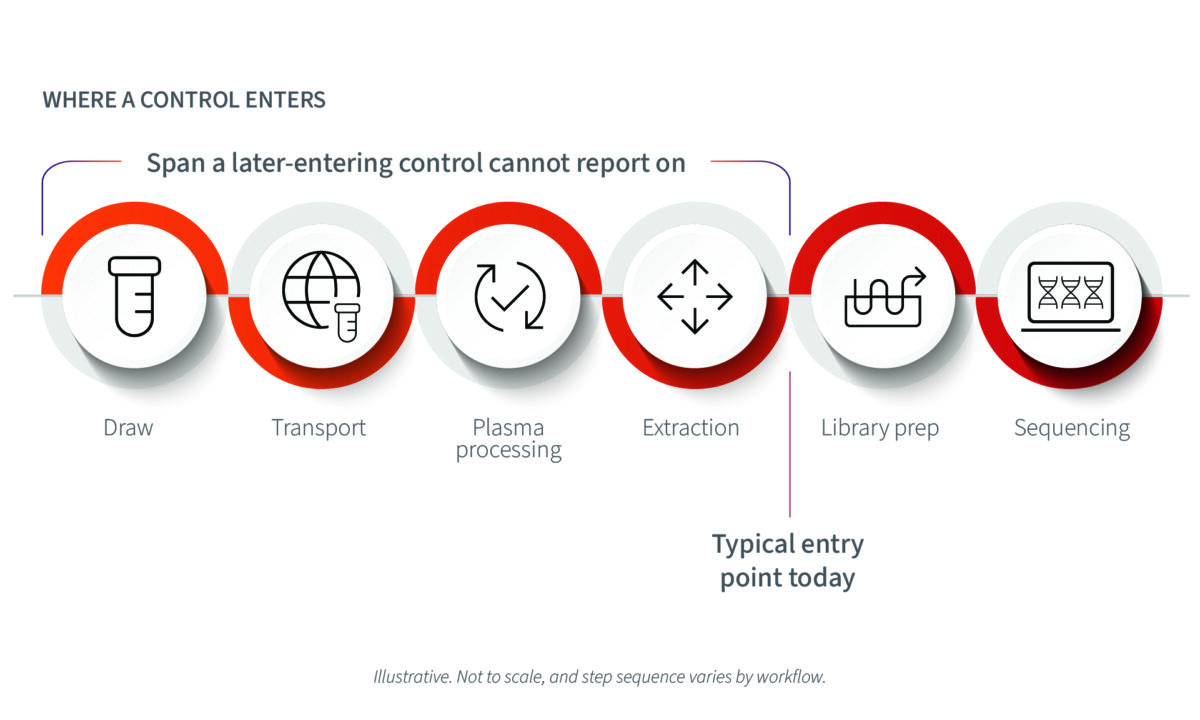
The untested span
Everything upstream of the control is unexamined.
A control reports on the steps it traveled through and is silent about the rest. That is not a shortcoming of any particular material, it is a property of where the material joins the workflow. This principle is already accepted in proficiency testing, where laboratories are expected to run assessment samples through their normal diagnostic process exactly as they would a clinical specimen.
What a later entry point covers
A reference material introduced as purified DNA at extraction can characterize everything downstream of that point.
- Extraction chemistry
Recovery and efficiency of the extraction method itself. - Library preparation
Input requirements, conversion efficiency, index handling. - Sequencing and pipeline
Depth, error correction, variant calling downstream.
What it leaves unmonitored
These steps happen to the patient sample and not to the control, so no result from that control describes them.
- The collection tube and the draw
Tube additives, fill, and the venipuncture itself. - Transport time and temperature
The interval between draw and processing, and the conditions across it. - Plasma processing
Centrifugation protocol and the handling that precedes extraction.
These steps are not incidental. Pre-analytical variables including tube type, processing delay, storage temperature, centrifugation protocol and extraction method are established as affecting cfDNA yield and integrity; one comparison of seven extraction kits found yield and fragment size varied significantly between them. Cell-free DNA levels have been shown to rise with time in K3EDTA tubes while remaining stable in stabilizing collection tubes, with the underlying mechanism being high molecular weight DNA released by lysis of peripheral blood cells during processing, which is not intended to be part of the ctDNA readout but can affect PCR and sequencing results.
What this costs you
The problem is not that results are wrong. It is that failures do not localize.
When a control returns something unexpected, the useful question is where. A control that was absent for half the workflow cannot answer it, and investigation falls back on re-running and elimination.
A positive blank does not localize the source
Signal in a blank establishes that contamination exists somewhere in the span the blank traveled. Contributions arising upstream of its entry point cannot be separated from those arising downstream, because the blank was never present for them.
A constructed negative cannot model biological background
Native cfDNA carries background from the donor’s own hematopoietic clones. Roughly 1.2 nonsynonymous mutations per sample have been detected in healthy individuals across a cancer gene panel, 58.4% of them passenger mutations of hematopoietic clones, with the positive rate rising to 76% above age 50. This background is a documented source of false positives in plasma genotyping, and it is absent by construction from material spiked into well-characterized wild-type DNA.
Low-frequency variants are where laboratories actually fail
An international assessment of 264 laboratories across 45 countries found an overall genotyping error rate of 11.1%, with low allelic frequency samples the most challenging and false negative rates higher below 1.5% VAF. An earlier pilot among 32 experienced laboratories reported a 20.1% scheme error rate.
Applies to any material, from any source
Evaluating oncology molecular reference materials for liquid biopsy workflows
Which reference material you validate against changes the analytical performance you measure. That makes control selection a validation decision rather than a procurement detail.
Discovery stage
What Streck is exploring
Three concepts, each built on the same premise: material that enters at the draw rather than after it. These are hypotheses under active validation with partner teams. None is an available product, none has an established regulatory classification, and nothing below should be read as a performance claim.
Coming Soon
Workflow and matrix-matched blank
Concept: a blank delivered in the same collection tube as a real draw and carried through the same transport, plasma processing and extraction steps, so that signal appearing in it would narrow to the process rather than leaving the upstream span unexamined.
Where it would apply: extraction, lot release, QC
Coming Soon
Wild-type cfDNA negative
Concept: a negative carrying native cfDNA background rather than a constructed one, matched to the workflow and the matrix, aiming at a noise floor that reflects what the assay will actually encounter.
Where it would apply: ctDNA, MRD, MCED, methylation and fragmentomics
Coming Soon
Custom and built-to-spec reference material
Concept: material specified around a particular assay. If neither of the above matches what your validation actually needs, the useful conversation is about what would, and that conversation is the point of this page.
Where it would apply: CDx programs, pharma trial sponsors, CROs and central labs, PT and EQA providers
Discovery input
Tell us what your assay actually needs.
Whether the entry-point is real in your workflow or not, either fill out a short, structured survey or speak with a specialist.
11%
Genotyping error rate
across 264 laboratories
45
Countries in that
assessment
76%
Positive rate for clonal
background above age 50